The S2V variant of Wan 2.2 is live in ComfyUI and drives full facial animation from raw audio — real people, cartoons, animals, digital humans all supported in the same checkpoint. The unlock operators are missing: voice separation is the quality multiplier; mixed-audio tracks produce noticeably degraded lip-sync vs. clean isolated vocals, making preprocessing a first-class pipeline step. Hardware floor is consumer VRAM on the fp8 checkpoint, with each 77-frame extension node covering roughly 3–4 seconds of final video.
A pipeline circulating in the ComfyUI community orchestrates all three engines as a unified system, auto-selecting based on clip length, quality target, and available VRAM. Series Entertainment documented the business case: 180x faster than manual production, 15 minutes of final video per creator per week, multiple Netflix titles shipped — treating the ComfyUI graph as a long-term production asset rather than a one-off generation step.
AI tool review and comparison content is sitting at $18–28 RPM in mid-2026, placing it inside the broader B2B SaaS tier that tops out at $30–50 — the highest CPM category on YouTube. The math is decisive: at $25 RPM, $1,000/month requires 40,000 views; in a $3 RPM entertainment niche, that same $1,000 costs 333,000 views.
As of 2026, Facebook treats every new video upload as a Reel, making the full catalog eligible for ad share, bonus programs, and Stars tipping. For operators already producing short-form AI content, this is a second major distribution platform at zero format conversion cost — the clips are already made.
Consensus across r/aivideo and creator forums has settled: "The era of upvoting a video just because AI made it is over." The community acts as a quality filter now, not a novelty amplifier. A platform order-volume proxy tracked 12,000 orders in December 2025 vs. 62,000 in January 2026 — a 417% MoM spike that coincided precisely with niche consolidation accelerating and general AI content losing ground.
The architecture brief: Wan 2.2 runs 27B total parameters but activates only ~14B per inference step via MoE routing — which is why the 5B model clears 8GB VRAM with ComfyUI's native offloading. LoRA training on a few dozen reference images unlocks character consistency across clips, making serialized content with recurring protagonists a viable production model on consumer hardware.
Creator Rewards combined with TikTok Shop affiliate integrations is generating higher per-post earnings than platform payouts alone. TikTok's updated policy confirms: enabling the AI-generated content label does not affect video distribution — transparency is no longer a distribution penalty, removing the last hesitation barrier for disclosure.
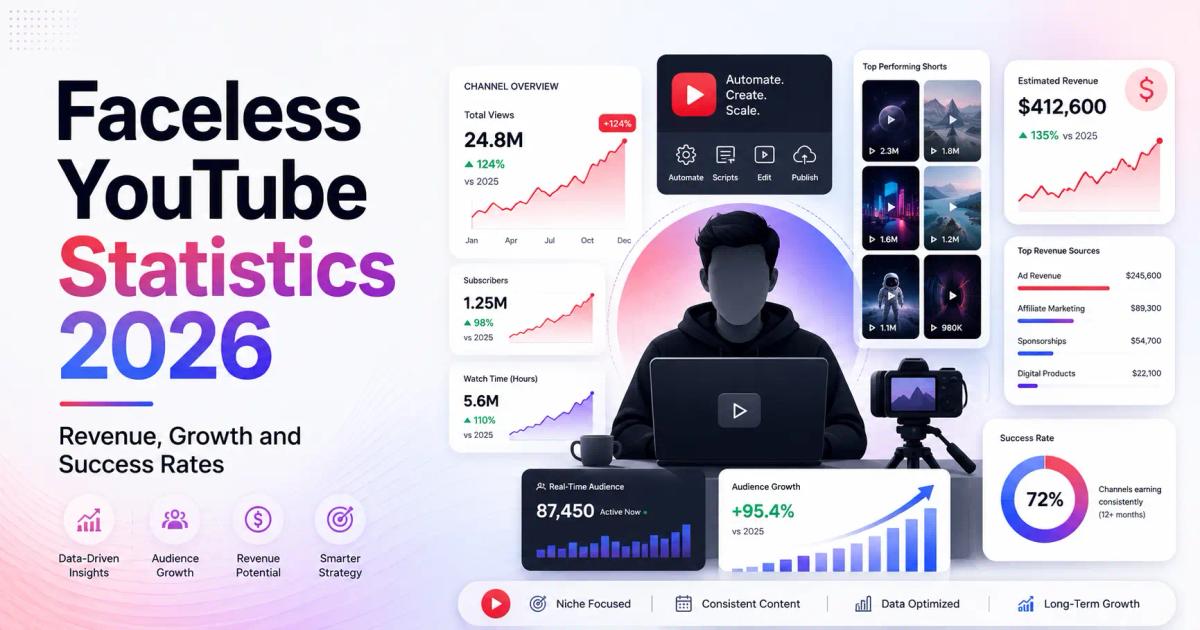
Faceless YouTube channels represent 38% of all new creator monetization ventures in 2026, up from 12% in 2022 — and 97% never reach monetization, with the primary failure point at months 4–6. The counter: 2026 AI workflows have compressed production to 80 minutes per video from the prior 6.5–8 hour benchmark, meaning operators can now test through to month six without burning unsustainable time.
YouTube Shorts is delivering 200 billion daily views at an average 14.3-second watch time, and 74% of those views come from non-subscribers. Shorts is the fastest new-audience acquisition tool on the platform — and the 10M Shorts views / 90-day threshold for full YPP ad revenue remains the fastest monetization path from a standing start.