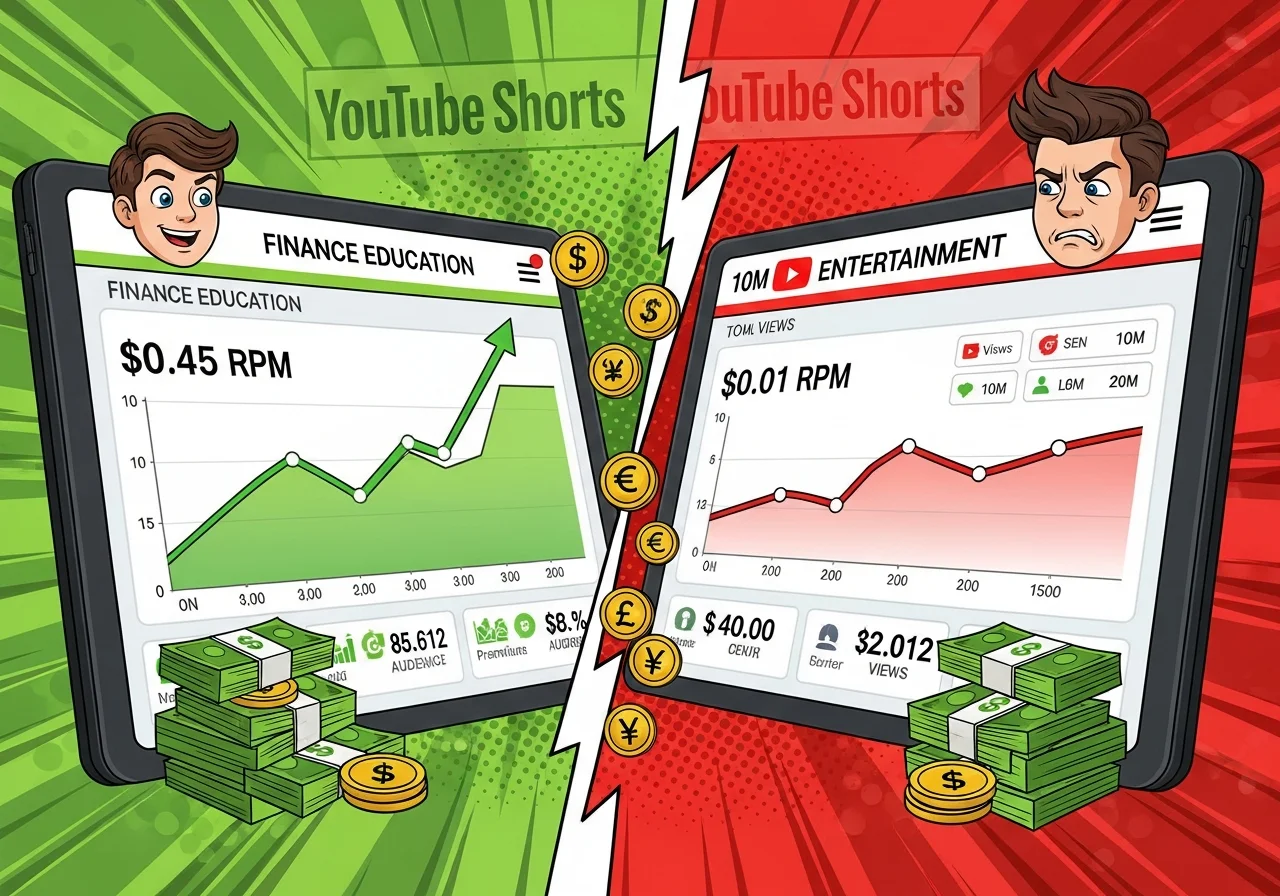
The 2026 RPM ladder is brutal but clear: finance and investing Shorts pull $0.15–$0.45 per thousand monetized views while comedy and entertainment scrape $0.01–$0.05 — a 10x gap on identical traffic. Underneath that, advertiser CPMs in finance hit $15–$50, and AI-tools content stacks 20–40% extra from affiliate on top of ad revenue. If you're picking a lane this quarter, niche selection out-leverages raw view count.
The persistent compounding-error problem — characters morphing, objects melting as clips lengthen — gets a real fix here via "Error Recycling Fine Tuning," training the model to recover from its own flawed frames. It chains clips into effectively infinite length with no added inference cost. Drop the High and Low noise SVI LoRAs into models/loras, run the official ComfyUI workflow at CFG 1.5, 6 steps, Euler — that's the whole setup.
The hard case study: Dharmendra Kumar's 1.5M-view Short earned ~$10 in ad revenue and ~$1,200 in affiliate sales off the identical clip. Jenny Hoyos pulled ~$1,200 from 22M views on ad share alone (~$0.055 RPM), then layers $5K–$10K monthly via sponsorships and funnels. The lesson is route every view to a product or affiliate offer — the platform's 45% cut is the floor, not the business.
The old Creator Fund is gone; Creator Rewards claims "up to 20x" the earning potential, but the door is narrower: original content one minute or longer, 10K followers, and 100K views in the trailing 30 days. The formula rewards originality, play duration, and search value — and AI content qualifies as long as you toggle the built-in AI-generated label. Beyond it sit Shop Affiliate, Series paywalls (up to 80 videos), and LIVE gifts.
As of May 2026 YouTube rolled out automatic detection of photorealistic synthetic media, slapping disclosure labels on even when creators forget. Paired with the inauthentic-content rules, that means mass-produced, repetitive AI-narration channels are getting swept into demonetization waves. AI-assisted content is explicitly still monetizable — the survival move is clean disclosure plus genuine original framing on every upload.
ByteDance's Seedance 2.0 (Feb 12) sits near the top of Artificial Analysis and lets you upload a reference video to dictate exact character motion — dance routines, staged gestures, the lot. Kling 3.0 (Feb 4) is the cinematic motion benchmark with native 4K, 60fps, 15-second clips and lip-sync in five languages, plus 6-shot storyboards. Most production teams now route across 2–3 models per scene rather than betting on one.
A Seedance-built comedy clip, "We need more data centers," hit 12.3K upvotes on r/aivideo, while a "What if Studio Ghibli directed Lord of the Rings?" piece pulled 7.5K upvotes on roughly $250 of mixed Kling, Sora, and Luma credits. The pattern: a sharp conceptual hook plus multi-model stitching beats single-tool spectacle, and the spend to land a front-page hit is still small money.
AI-generated content now makes up 38% of viral TikTok videos, and 93% of top viral clips use custom sound design rather than stock audio. The 2025 playbook — hyper-real spectacle, surreal morphs, abstract diffusion art — is dead weight; 2026 rewards structured, character-driven, retention-optimized formats. Audio is no longer the afterthought; it's a gating factor for the algorithm.